Why do specialized fire trucks use foam instead of water? The short answer is fuel behavior. Water cools hot materials, but a burning liquid fuel can float on water and spread. Foam mixes water with a foaming agent, then blankets the fuel with bubbles. That layer helps limit oxygen contact and suppress flammable vapors. It can also reduce the chance of reignition. Foam is not magic, though. Its performance depends on the fuel, application method, and chosen formulation.
NFPA’s U.S. Fire Experience report estimated 1,504,500 fires in the United States in 2022. That broad figure does not measure foam effectiveness, but it shows the scale of the fire-service challenge. For technical context, NFPA 11 covers foam systems, while FAA Advisory Circular 150/5210-6D addresses aircraft fire-extinguishing agents. Fire-protection engineer Dr. Vytenis Babrauskas’s published fire-science work supports a practical takeaway: match the suppression method to the fuel and fire conditions. This is a paraphrase, not a verified verbatim quotation.
On an airport apron, a foam blanket can settle over spilled jet fuel while crews cool nearby surfaces with water. That distinction matters. Many specialized trucks carry both agents, not foam alone. Foam types also differ, and some formulations raise environmental concerns. A careful answer must leave room for that trade-off. The best choice is not always obvious in the heat of a real incident.
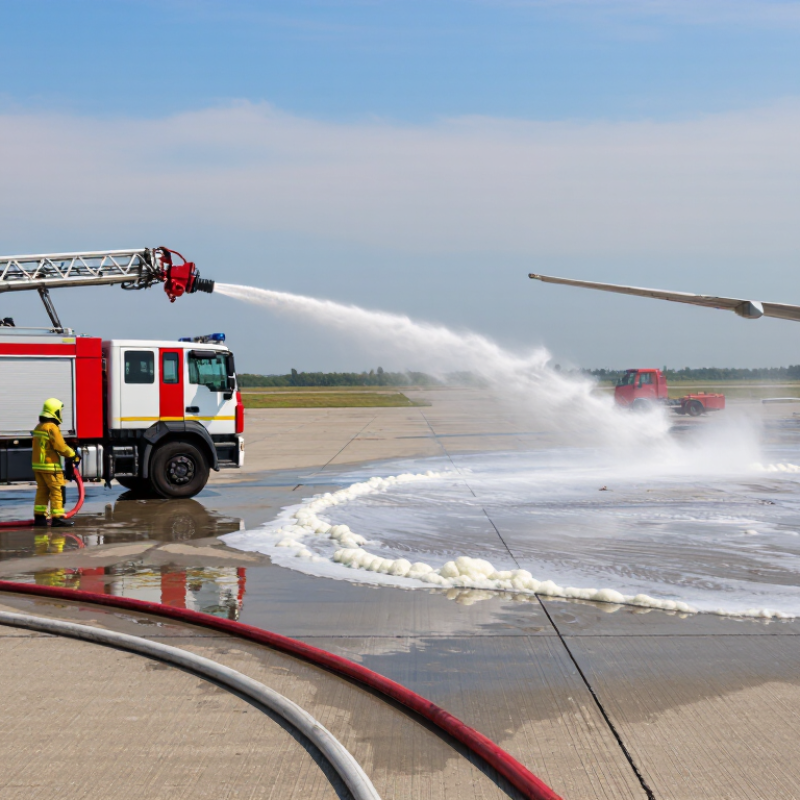
A water stream can cool a surface, but it may not control a burning fuel layer. NOAA’s CAMEO Chemicals database places gasoline’s specific gravity around 0.7–0.8, depending on its blend. Since it is lighter than water, spilled gasoline can float and spread across water instead of mixing with it. If water is poured forcefully onto a fuel fire, the burning liquid may be driven outward, carrying flames toward nearby equipment or drains.
That matters.
A shiny, thin sheet of fuel can cover more ground than expected.
Foam works differently. Firefighting foam is applied to form a blanket over the fuel, helping suppress flammable vapors and limit their contact with air. NFPA 11 describes foam systems for controlling flammable-liquid fires; the right foam type and application depend on the fuel and incident conditions. Water still has important cooling uses, including protecting nearby tanks and structures, but it is not a universal replacement for foam on hydrocarbon spills.
The picture is not always tidy:
Wind, broken foam cover, and uneven ground can undermine the blanket.
Not always.
Operators need to match the agent and technique to the hazard.
On a fireground, foam is not simply stronger water. It is a water-based solution mixed with concentrate and air, then discharged through equipment designed to create bubbles. NFPA 11 classifies low-expansion foam by its expansion ratio: up to 20:1. In practical terms, one volume of foam solution can produce as much as twenty volumes of finished foam. The ratio describes expansion, not extinguishing power. That distinction matters. Low-expansion foam stays relatively dense, reaches a burning liquid surface, and can spread into a protective blanket.
That blanket helps separate fuel vapors from the air and limit vapor release. The water in the foam also absorbs heat. On a spill fire, crews may watch foam cover the liquid and fill gaps around obstacles. It is not magic. Wind, drainage, fuel type, application rate, and damaged bubbles can weaken coverage. A surface may look covered while thin spots remain. That is easy to miss. Operators need suitable proportioning and careful application, with reapplication if the blanket breaks. Foam does not replace water in every fire; it changes how water is delivered and retained where a continuous surface layer is useful.
Low-expansion foam has an expansion ratio of up to 20:1 under NFPA 11. At a 20:1 ratio, one liter of foam solution produces about 20 liters of finished foam. The aerated foam can blanket fuel and help suppress flammable vapors; water remains useful for cooling. The chart shows volume conversion, not fire-suppression performance.
A foam setting of 1%, 3%, or 6% describes concentrate as a share of the finished foam solution. At 3%, for example, 100 gallons of solution contains about 3 gallons of concentrate and 97 gallons of water. It does not describe how much finished foam the truck produces. That depends on the equipment and aeration. Small changes count.
NFPA 11 provides technical guidance for foam systems, while UL 162 covers foam equipment and liquid concentrates. Their standards help explain why crews must match the proportioning rate to the concentrate’s tested use and the fuel involved. A 1% product is not automatically interchangeable with a 3% product. The correct setting comes from the product’s approved specifications and the truck’s proportioning system, not guesswork at the panel.
On scene, that difference can become tangible: a misadjusted system may draw too little concentrate, even when the tank is full. Crews and technicians check proportioners, flow conditions, and maintenance records to confirm delivery. These checks matter, but paperwork cannot reveal every field variation. That is worth remembering. Temperature, equipment wear, and operating conditions can affect performance, so a printed percentage is only one part of readiness.
A proportioner is the dosing control between the water tank and the foam line. It draws concentrate from a separate tank and meters it into moving water. At a 3% setting, 3 liters of concentrate make 100 liters of finished solution; the remaining 97 liters are water. Small doses matter. Too little can weaken the finished foam, while excess concentrate wastes stock and may alter its performance.
Proportioners use different methods. An in-line eductor uses water flow and pressure to pull concentrate through a pickup tube. Pump-based systems can meter concentrate more directly and adjust delivery as water flow changes. Sensors and calibrated controls help maintain the selected percentage, but pressure losses, clogged strainers, and concentrate temperature can affect real-world performance. The neat diagram is not the whole story. NFPA 11 (2024) sets design and application criteria for foam systems; crews must also follow the concentrate’s listed proportioning rate and equipment instructions. A practical check is to compare the selected percentage with measured water and concentrate use during a controlled test. Even experienced operators can miss drift if they trust a dial without checking the output.
Specialized fire trucks use foam when burning liquid fuel can release flammable vapors. Foam spreads across the surface, separating fuel from air and slowing vapor escape. Water alone may cool the area but can spread some burning liquids. The blanket is not permanent. Heat, wind, and moving equipment can break it, so crews watch the surface and reapply foam where gaps appear.
Replenishment is the operational cost. NFPA 11 describes foam proportioning rates that include 1%, 3%, and 6%, depending on the concentrate and system.
At a 3% rate, 1,000 gallons of finished foam solution uses about 30 gallons of concentrate. The arithmetic is unforgiving. A long discharge can empty a truck’s concentrate tank well before its water supply runs dry.
FAA guidance for airport rescue and firefighting also sets agent quantities and discharge requirements by airport category, underscoring that crews must plan supply around the incident, not just the first attack.
In practice, operators track concentrate levels, check proportioning equipment, and coordinate refill access. Even good planning can miss the mark when fire conditions shift quickly.
Foam can suppress vapors, but crews still need enough reserve to maintain the blanket and manage runoff safely.
One volume of foam solution can produce up to twenty volumes of finished foam. The ratio describes expansion, not extinguishing power.
Its dense bubbles can spread into a blanket over the liquid. The blanket limits fuel vapors mixing with air, while its water absorbs heat. It is not magic.
Yes. Thin spots may hide around obstacles, even when most of the surface looks covered. Wind and damaged bubbles can weaken the blanket.
They describe the concentrate’s share of the finished foam solution. At 3%, 100 gallons of solution contains about 3 gallons of concentrate and 97 gallons of water.
No. Equipment and aeration affect finished foam volume. That neat percentage can be misleading on its own.
Not automatically. The correct setting depends on the concentrate’s approved specifications and the proportioning system. Guessing at the panel is risky.
Incorrect settings, flow conditions, equipment wear, or temperature may affect delivery. A full tank does not guarantee the right mixture. Checks help, but field variation remains.
They may need to reapply it if the blanket breaks or gaps appear. Drainage, wind, fuel type, and application rate can affect coverage. A quick visual check may miss a weak spot.
Why do specialized fire trucks use foam instead of water? On fuel fires, water alone may be ineffective because many hydrocarbons float on water, allowing burning liquid to spread and carry the fire to new areas. Firefighting foam helps by forming a blanket over the fuel, suppressing flammable vapors and limiting contact with air. Under NFPA 11, low-expansion foam has an expansion ratio of up to 20:1, meaning the finished foam can occupy up to twenty times the volume of the mixed solution.
To produce the right mixture, a truck’s proportioning system meters foam concentrate into its water supply. Common concentrate settings are 1%, 3%, or 6%, selected according to the operation and the concentrate’s instructions. Foam can improve control and reduce the risk of vapors reigniting, but it is not limitless: crews must monitor their supply and replenish concentrate as needed. Its effectiveness therefore depends on choosing an appropriate mixture and applying enough foam to maintain a protective blanket.

Flex Truck