7 Best Ways to Secure Heavy Machinery on a Lowboy Trailer?

Time:2026-10-26 Author:Oliver
0%

Moving a 30-ton excavator is not merely a loading task. It is a risk-control exercise involving weight, movement, friction, equipment condition, and road vibration. A loose attachment can swing across the deck. A small gap can become a serious problem after several miles of braking and turning.

This guide explains how to secure heavy machinery on a lowboy trailer through seven practical methods. The recommendations reflect common field practices, manufacturer instructions, and guidance from the Federal Motor Carrier Safety Administration’s Cargo Securement Handbook. They also consider cargo-securement findings reported through the Commercial Vehicle Safety Alliance’s annual International Roadcheck program. Those industry sources repeatedly emphasize securement strength, suitable tiedown placement, inspection, and load stability.

The process starts before the machine reaches the trailer. Operators should confirm the trailer’s rated capacity, deck condition, ramp angle, axle distribution, and equipment weight. Clean contact surfaces matter. Mud, oil, and loose gravel can reduce friction between steel tracks and the deck. Use rated chains, binders, chocks, and edge protection where appropriate. Never rely on hydraulic pressure, parking brakes, or the machine’s weight alone.

Details matter here. A compact loader may need different restraint points than a tracked excavator. Attachments should be lowered, secured, or removed according to the manufacturer’s instructions. Recheck every connection after the first short distance. It may feel excessive. It is not. Many real-world failures begin with assumptions that seemed reasonable at the loading site. Proper securement is not a single action; it is a repeatable inspection discipline.
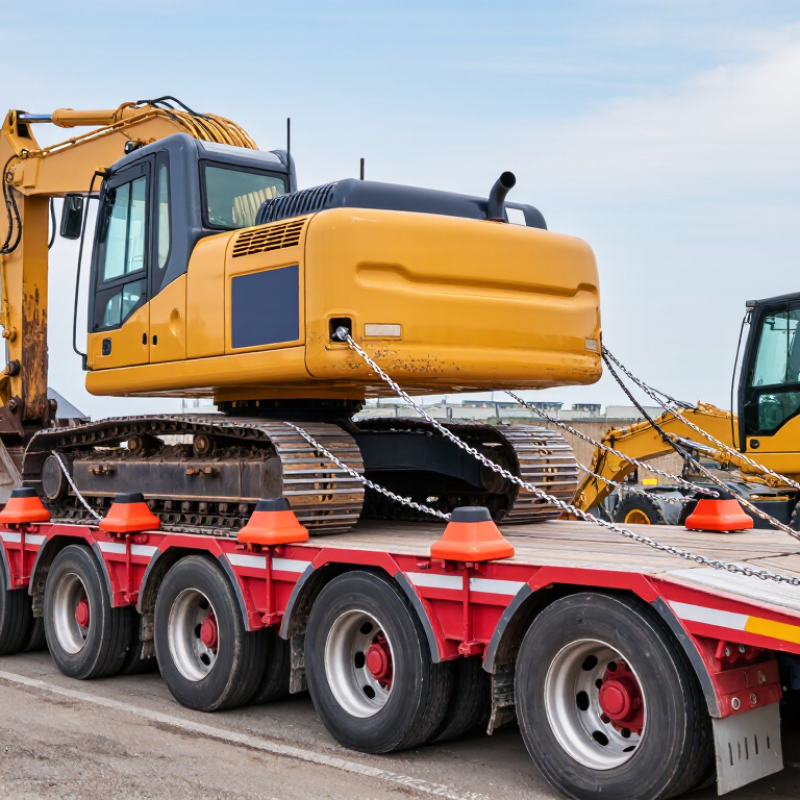
7 Best Ways to Secure Heavy Machinery on a Lowboy Trailer?

Choosing the Right Lowboy Trailer and Tie-Down Equipment

Choosing the right lowboy trailer starts with the machine, not the available trailer. Confirm gross weight, axle spacing, ground clearance, track width, and attachment points. A trailer should carry the load within its rated capacity, with balanced axle loading and enough deck length. Removable goosenecks can simplify loading, while ramps must support the machine’s concentrated wheel or track pressure. I have seen operators choose a trailer by overall length alone. That shortcut can create poor weight distribution.

Tie-down equipment must match the machine’s weight and movement risk. Under FMCSA cargo-securement guidance, the aggregate working load limit of tiedowns should equal at least 50% of the cargo weight. Use rated chains and binders, attach them to strong frame points, and protect them from sharp edges. Add blocking, friction mats, or chocks when tracks or tires may roll. Never treat hydraulic pressure as securement.

The FMCSA Large Truck Crash Causation Study identified cargo shift as a factor in about 4% of studied heavy-truck crashes. That figure is small, but the consequences are not. CVSA’s 2024 International Roadcheck recorded 48,761 inspections and listed cargo securement among leading vehicle out-of-service concerns. Inspect the setup after the first 50 miles, then again after three hours or 150 miles. Recheck after hard braking, rough roads, or weather changes. Sometimes the first arrangement looks perfect. It may still need adjustment.

Inspecting Heavy Machinery Before Loading

Inspecting Heavy Machinery Before Loading

Before securing heavy machinery, inspect it on firm, level ground. A careful inspection reduces surprises during loading and transport. In my field experience, small defects often become serious movement problems on the trailer. Walk around the machine slowly. Check tires, tracks, rims, hydraulic lines, steps, guards, and access points. Look for fresh oil, cracked welds, loose panels, or damaged lifting eyes.

Confirm the machine’s operating weight and overall dimensions from reliable equipment records. Measure attachments separately when their position changes the load length. Check the center of gravity, especially when booms, buckets, or arms are raised. Lower moving parts whenever the equipment design allows it. Remove tools, debris, and unsecured materials from the cab and frame. Do not guess.

Inspect the trailer deck, ramps, pockets, and anchor points before loading. They must be clean, dry, and free from serious damage. A second trained person should observe clearance and communicate with the operator. Keep bystanders outside the loading zone. I used to focus mainly on chains and binders, but that was incomplete. A leaking line or weak attachment point can undermine excellent restraint work. Record defects with photographs, then pause loading until a qualified person evaluates them. Safety records should include the machine weight, inspection time, visible damage, and any corrective action taken.

7 Best Ways to Secure Heavy Machinery on a Lowboy Trailer: Inspecting Heavy Machinery Before Loading

Before loading, verify the machine’s gross weight and confirm that the combined working load limit (WLL) of the tie-downs is at least 50% of the cargo weight, as required by U.S. heavy-equipment securement rules. The chart shows the minimum aggregate WLL for several machinery-weight scenarios.

Positioning and Balancing the Load on the Trailer

Positioning heavy machinery on a lowboy trailer begins before the first chain is tightened.

Inspect the deck, ramps, tie-down points, and axle limits. Confirm the machine’s operating weight, attachment position, and center of gravity. A wide excavator may look stable, yet a raised boom can shift weight quickly. Keep the heaviest section over the trailer’s strongest load area, not simply near the rear. Lower blades, buckets, and booms as far as the equipment design allows. Shut down, secure moving parts, and remove loose tools from the deck.

Balance the load across the trailer’s width and length. Avoid placing all weight behind the rear axle group. That can reduce steering control and overload the trailer structure. Too much weight forward creates another problem: poor maneuverability and excessive pressure on the towing vehicle. Measure axle loads when possible, especially with compact trailers or unusually dense machinery. Use timber blocking only when it is rated, dry, and placed on solid contact points. Check clearances around fenders, ramps, and suspension components. Small shifts matter.

Tips: Park on level, firm ground whenever possible. Center the machine before applying restraints. Recheck its position from both sides. If the trailer leans, stop and correct it. Use a spotter during loading, but agree on clear commands beforehand. After a short drive, inspect tension, blocking, and attachment movement. I have seen a carefully tied load settle after the first few miles. That does not always mean the setup was careless. Real transport conditions can reveal assumptions worth challenging.

Applying Chains, Binders, Blocks, and Other Restraints

Securing heavy machinery on a lowboy trailer demands more than tightening a few chains. From field experience, I begin by centering the machine and checking its weight distribution. The deck must remain stable during braking, turning, and uneven-road movement. I use chains rated for the load, then connect them to strong structural points. Binders should sit where they stay accessible and cannot contact moving parts. Always secure binder handles against accidental release.

Blocks and chocks provide vital support around wheels, tracks, or rollers. They reduce shifting, but they should not replace tiedowns. Clean friction mats can limit sliding between the machine and deck. They work poorly when covered with oil, mud, or loose gravel. Edge protectors guard chains and straps from sharp corners. They also spread pressure across painted surfaces. A separate restraint may be needed for detachable attachments, buckets, ramps, or loose tools. Small items become dangerous projectiles.

I inspect every connection before departure, including hooks, links, anchor points, blocks, and binder tension. After the first short drive, I stop and check them again. This step is easy to skip. I have made that mistake before. Vibration can loosen a binder even when the load looked secure at the yard. Keep restraints clear of exhaust heat, hydraulic lines, and pinch points. Replace damaged equipment rather than trusting a temporary fix. Follow the applicable load-securement requirements and the trailer manufacturer’s instructions for every haul.

Checking Securement, Clearance, and Road Readiness

A secure heavy machine begins with a calm, physical inspection. Confirm the load sits centered over the lowboy trailer. Keep attachments lowered, folded, or removed when practical. Use approved securement points, rated chains, binders, and edge protection. Check the deck for oil, mud, loose boards, or damaged tie-down points. The machine must not shift, bounce, or roll during braking.

Clearance needs equal attention. Measure the total height from the road surface, not only from the trailer deck. Include exhaust stacks, cabs, booms, buckets, mirrors, and raised handrails. Check side width near the widest attachment. Walk the planned route mentally. Bridges, signs, wires, narrow shoulders, and steep crossings can create surprises. Road readiness also means inspecting tires, brakes, lights, flags, ramps, and locking pins. Recheck every binder after a short, controlled drive.

Tips: Use a written checklist and a second pair of eyes. Mark the measured height clearly inside the cab. Stop if anything looks different. No shortcut is worth guessing. A perfect checklist does not replace judgment. I have learned that rushed final walks hide small problems, especially loose attachments and overlooked clearance points. Let the machine settle before tightening securement again.

7 Best Ways to Secure Heavy Machinery on a Lowboy Trailer? - Checking Securement, Clearance, and Road Readiness

No. Securement Method Best Application Planning Data or Check Inspection Standard Road-Readiness Result
1 Use rated chains and binders for direct tie-downs Excavators, loaders, dozers, rollers, and other tracked or wheeled equipment with suitable attachment points. For a 40,000 lb machine, the aggregate working load limit of the tie-down system should be at least 20,000 lb where the applicable U.S. cargo-securement rule requires 50% of cargo weight. An example is four tie-downs rated at 10,000 lb each, providing 40,000 lb aggregate WLL. Confirm the chain, binder, hooks, and anchor points have visible capacity markings or documented ratings. Do not use bent hooks, stretched chain links, cracked welds, or damaged binders. The machine remains centered, restrained in forward and rearward directions, and cannot shift, roll, or pivot during braking, acceleration, or turning.
2 Block, brace, and chock the equipment Wheeled machinery, machines with smooth steel tracks, and equipment that could roll or slide if a tie-down loses tension. Use solid blocking that is suitable for the machine load and deck surface. Place chocks tightly against wheels or tracks without relying on chocks as the only restraint. Check that blocks are not split, crushed, loose, or positioned where they can fall from the trailer. Verify that the machine is not resting on hoses, wiring, or vulnerable components. Blocking supplements tie-downs and limits movement in the direction of travel, especially during emergency braking.
3 Secure attachments and movable components Booms, buckets, blades, forks, outriggers, counterweights, ramps, doors, and other detachable or articulated parts. Lower attachments onto secure supports where possible. Retract cylinders, lock articulation points, pin removable components, and tie down each item that could swing, drop, or extend beyond the machine body. Check retaining pins, locking devices, safety clips, hydraulic locks, and secondary tie-downs. Inspect for hydraulic leakage that could allow an attachment to move. No attachment can move independently, contact the road surface, strike another vehicle, or exceed the planned width or height envelope.
4 Use protected anchor points and edge protection Machinery with painted surfaces, sharp edges, fragile hydraulic lines, or tie-down angles that could damage straps or chains. Connect tie-downs to structural anchor points on the trailer and machine. Use edge protection where a strap or chain contacts a sharp corner or abrasive surface. Ensure tie-downs do not contact exhaust components, rotating parts, hydraulic hoses, electrical wiring, or sharp metal edges. Replace cut, abraded, melted, or chemically damaged webbing. The restraint system stays attached and retains its rated capacity throughout the trip without cutting into the load or trailer.
5 Distribute weight across the lowboy deck and axles High-center-of-gravity machinery, long tracked equipment, and loads approaching the trailer's rated capacity. Confirm the machine weight, trailer tare weight, axle-group ratings, tire ratings, kingpin or hitch capacity, and gross combination limit. Keep the center of gravity low and avoid excessive front or rear loading. Review scale readings or a verified weight calculation. Check that tires, suspension, deck, ramps, and anchor points are not overloaded or visibly deflected. Axle and gross weights remain within the legal and equipment-specific limits for the intended route and permit conditions.
6 Measure height, width, length, and ground clearance Tall excavators, raised booms, wide attachments, long machines, and loads traveling under bridges or through restricted routes. Measure from the road surface to the highest point after loading. Also measure overall width, length, rear overhang, and the lowest point under the trailer or load. Route limits vary; a commonly used U.S. reference for standard vehicle height is 13 ft 6 in, but local rules may differ. Recheck measurements after suspension settles and after attachments are secured. Verify bridge, utility-line, railroad-crossing, lane-width, and turning-clearance information along the route. Dimensions match the permit or route plan, required warning devices are installed, and no component can contact the pavement or overhead obstruction.
7 Complete a pre-trip and en-route securement inspection Every heavy-machinery move, particularly after loading, during the first part of the trip, and after hard braking or rough road conditions. Perform a complete inspection before departure and recheck the load within the first 50 miles when operating under common U.S. cargo-securement practice. Continue periodic checks during the journey and after any unusual event. Look for loose binders, reduced tension, shifted machinery, damaged tie-downs, leaking tires, loose pins, missing flags, and changes in clearance. Correct defects before continuing. The driver has confirmed securement, lighting, tires, brakes, permits, warning signs, emergency equipment, and route documents before and during travel.
Important planning note: Securement requirements vary by jurisdiction, machine type, trailer design, cargo weight, road classification, and permit conditions. Treat the numerical values above as planning references only; verify the applicable regulations, manufacturer instructions, trailer ratings, and route-specific requirements before departure.

FAQS

How do I choose the right lowboy trailer for heavy equipment?

Start with the machine, not the trailer. Check weight, axle spacing, track width, ground clearance, and attachment points. The trailer must support balanced axle loading. Overall length alone can mislead.

Why are ramps important during loading?

Ramps must handle concentrated wheel or track pressure. Inspect their condition and rated capacity. A heavy track can create intense pressure in one small area. Move slowly.

How much tie-down capacity is needed?

The combined working load limit should equal at least 50% of the cargo weight. Use rated chains and binders. Attach them to strong frame points, not weak panels.

Should hydraulic pressure hold a machine in place?

No. Hydraulic pressure is not securement. Lower blades, buckets, and booms when practical. Lock moving parts and remove loose tools from the deck.

Where should the heaviest part of the machine sit?

Keep it over the trailer’s strongest load area. Balance weight across the length and width. Avoid loading everything behind the rear axle group. Small shifts matter.

What should I use to prevent rolling or sliding?

Add blocking, friction mats, or chocks when tracks or tires may move. Use dry, rated timber on solid contact points. Protect chains from sharp edges.

How can I check the machine before starting the trip?

Confirm the load is centered and attachments are lowered or folded. Inspect chains, binders, blocking, ramps, lights, brakes, tires, and locking pins. Walk around both sides.

How should I verify clearance along the route?

Measure total height from the road surface. Include booms, buckets, exhaust stacks, mirrors, and handrails. Check bridges, wires, signs, narrow shoulders, and steep crossings.

When should I recheck the securement?

Inspect it after the first 50 miles. Check again after three hours or 150 miles. Stop sooner after hard braking, rough roads, or weather changes. A setup may settle.

What if the trailer leans or the load looks different?

Stop and correct the problem before continuing. Use a spotter with agreed hand signals during loading. A checklist helps, but judgment still matters. Rushing can hide small problems.

Conclusion

Learning how to secure heavy machinery on a lowboy trailer begins with selecting a trailer and tie-down equipment that match the machine’s weight, dimensions, and configuration. Before loading, inspect the equipment for loose parts, leaks, damaged attachment points, and unsecured components. Confirm that ramps, decks, and access areas are clean and capable of supporting the load. Once positioned, place the machinery centrally and distribute its weight evenly to maintain stability and reduce unnecessary stress on the trailer.

Use properly rated chains, binders, blocks, wedges, and other restraints to prevent forward, backward, and sideways movement. Attach restraints to strong, approved securement points without contacting fragile parts or creating sharp bends. After tightening, inspect every connection, confirm adequate clearance around the load, and verify that no component can drag, shift, or obstruct visibility. Recheck the securement before departure and during planned stops, making adjustments whenever necessary to keep the machinery stable and road-ready.

Oliver

Oliver

Oliver is a seasoned marketing professional with a wealth of expertise in driving brand awareness and engagement. With a deep understanding of our company's product offerings, he consistently delivers high-quality content that enriches our professional blog. His insights not only shed light on......