When considering various types of trucks, one question often arises: what is the difference between a tractor truck and a rigid truck? Understanding these key differences can significantly impact logistics and transportation choices. Tractor trucks, with their powerful engines, are designed for heavy towing. They feature a detachable trailer, making them versatile for various loads. In contrast, rigid trucks boast a fixed body, combining the cab and cargo area. This design is ideal for urban deliveries and shorter hauls.
The specialization of each truck type reflects their intended use. Tractor trucks excel on highways, carrying large freight over long distances. Rigid trucks, however, navigate streets easily, delivering goods directly to businesses. Each type has advantages and limitations that must be considered.
Many people underestimate the importance of choosing the right vehicle. Mistakes can lead to inefficiencies and increased costs. Knowing what is the difference between a tractor truck and a rigid truck empowers businesses to make informed decisions. Such knowledge is essential for optimizing transportation operations and enhancing supply chain management.
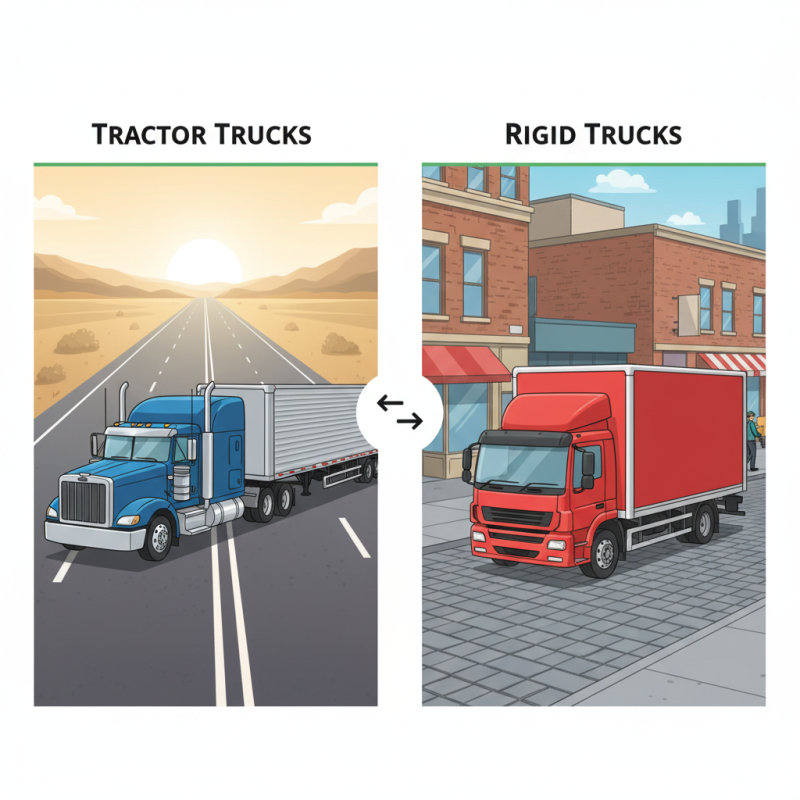
Tractor trucks and rigid trucks serve distinct purposes in the transportation sector.
Tractor trucks are designed to pull trailers. They have a unique structure that allows them to connect to various trailer types. The cab and the separate trailer ensure flexibility. This makes them ideal for long hauls, as they can easily adapt to different cargo needs. They excel in transporting goods across vast distances.
On the other hand, rigid trucks feature a single, solid chassis. The cab and cargo area are fixed together, which limits their versatility for different loads.
Rigid trucks are better suited for local deliveries. They navigate urban areas with greater ease, making them perfect for short-distance jobs. Their design enables them to carry heavy loads, but changing cargo types frequently is a challenge.
In choosing between the two, consider the job requirements. Are you making local deliveries or hauling goods over long distances? The answer will guide your decision. While both truck types have their advantages, recognizing the strengths and limitations of each is critical for effective transportation management.
Tractor trucks and rigid trucks serve distinct purposes in the transportation industry. A tractor truck typically has a cab and a separate trailer. This design allows for better maneuverability and flexibility, accommodating various loads. The ability to detach the trailer enables drivers to haul different cargo types with ease. In contrast, rigid trucks have a single body. This makes them straightforward and easier to operate in urban settings. They are ideal for local deliveries due to their compact size.
Structurally, tractor trucks often come with a more powerful engine. This is necessary for towing heavy trailers over long distances. Rigid trucks, while powerful, are generally optimized for shorter hauls. They have lower payload capacities compared to tractor trucks but excel in stability. The absence of a trailer makes them simpler in design but not as versatile. The choice between the two often depends on specific delivery needs and logistics.
Understanding these differences is crucial for fleet operators. It helps in selecting the right vehicle for the logistics chain. Each design has its pros and cons, which require careful consideration. Not every operation benefits from using a tractor truck, nor is a rigid truck suited for every task. Insight into these structural differences can lead to better operational efficiency.
| Feature | Tractor Trucks | Rigid Trucks |
|---|---|---|
| Structure | Consists of two parts: the cab (tractor) and the detachable trailer | Single rigid structure where the cab and cargo area are fixed together |
| Flexibility | Highly flexible; can change trailers to transport different loads | Less flexible; designed for specific loads and purpose |
| Turning Radius | Wider turning radius due to the length of the vehicle | Tighter turning radius, making it more maneuverable in urban environments |
| Load Capacity | Can often handle heavier loads with the correct trailer | Typically has a fixed load capacity based on the size of the truck |
| Common Uses | Long-haul transportation and freight with variable cargo | Local deliveries, construction, and specific industries |
Tractor trucks are widely used in logistics and transportation due to their flexibility and efficiency. They serve as the backbone of freight movement across long distances. According to the American Trucking Associations, over 72% of freight in the U.S. is moved by trucks. This statistic highlights the critical role tractor trucks play in the economy.
Common applications for tractor trucks include hauling large shipping containers, bulk goods, and heavy machinery. These vehicles excel in long-haul operations, making them indispensable for shipping companies. Their ability to connect with different types of trailers makes them versatile. Cargo can range from perishable items to construction equipment. The adaptability of tractor trucks ensures they meet various industry demands effectively.
Despite their advantages, operating tractor trucks involves challenges. Drivers often face long hours on the road, impacting their well-being. Additionally, maintenance costs can be higher than expected due to wear and tear from heavy loads. Industry data suggests that, on average, a tractor truck may incur maintenance costs of 12-15 cents per mile. Understanding these aspects is crucial for companies to optimize their logistics operations and support driver welfare.
Rigid trucks, also known as box trucks or straight trucks, are widely used in various industries. Their design consists of a single chassis and cabin, with the cargo area attached directly to the frame. This makes them very versatile for transporting goods. Common applications include moving furniture, delivering packages, and transporting construction materials. They are particularly effective for short-haul deliveries due to their maneuverability in urban areas.
For businesses, using rigid trucks can optimize efficiency. They usually have a lower loading height, which simplifies loading and unloading tasks. However, planning routes is crucial to avoid traffic and delays. Tip: Always consider the size of your load and the area where you will operate. Accurate measurements can save time and prevent damage.
In construction, rigid trucks play an essential role. They transport heavy materials like bricks and concrete. Their stability on the road helps to ensure safety during transit. Yet, these trucks may struggle with sharp turns and narrow streets. Tip: Assess the road conditions and parking space before making deliveries. It can lead to smoother operations and less stress for the drivers. Rigid trucks are dependable, but their use requires careful consideration of logistics.
When comparing tractor trucks and rigid trucks, each has its pros and cons. Tractor trucks are designed for long-haul transport. They can pull various types of trailers, providing flexibility for moving freight. This design allows for larger cargo volumes, which is beneficial for businesses. However, their maneuverability in tight spaces can be limited, posing challenges in urban settings.
On the other hand, rigid trucks have a fixed body, making them easier to handle in smaller areas. They are ideal for local deliveries. Their design allows for quick loading and unloading. However, their cargo capacity is often smaller than that of tractor trucks. This may require more trips for large shipments, which can increase operational costs. Balancing the need for capacity with the ease of navigation is crucial for logistics planning. Understanding these strengths and weaknesses is essential for making informed choices.
: Tractor trucks are designed to pull trailers, accommodating various cargo types for long-haul transport.
Rigid trucks have a single, solid chassis, making them less versatile but easier to operate in urban areas.
They offer flexibility for moving large cargo volumes, making them ideal for diverse freight transport needs.
Rigid trucks are better for local deliveries, especially in tight spaces, due to their compact design.
Their size can limit maneuverability in urban environments, making navigation challenging in crowded areas.
Their smaller cargo capacity often requires more trips for large shipments, which can increase costs.
Consider job requirements, such as delivery distance and cargo type, to select the appropriate truck for the task.
No, not all operations benefit from tractor trucks; decisions should be based on specific logistics needs.
Rigid trucks may struggle with changing cargo types frequently due to their fixed design.
Insight into the strengths and weaknesses of each truck type can lead to better operational efficiency and decision-making.
In exploring the question of what is the difference between a tractor truck and a rigid truck, it is essential to understand their definitions and structural characteristics. Tractor trucks are designed to pull trailers, featuring a separate cab and trailer, while rigid trucks have a fixed design where the cargo area is attached directly to the chassis. This key structural difference influences their capabilities and maneuverability.
When it comes to applications, tractor trucks are commonly used for long-haul transportation, enabling the movement of large quantities of goods across long distances. Rigid trucks, on the other hand, are often utilized for local deliveries and short-distance transport due to their stability and ease of navigation in urban environments. Each type has its distinct advantages and disadvantages, such as the flexibility of tractor trucks versus the simplicity and reliability of rigid trucks, making the choice between them largely dependent on specific transportation needs.

Flex Truck